
Blue White Red

I am still new at embracing the label “artist”, but now I realize I have always been one. Calling myself a creative is still more comfortable. If you would have asked any of my classmates, elementary through high school, what I was going to study in college, 95% of them would have said: art, but doing that was out of the question. There was absolutely no way I would do this to my mother. I don’t remember anyone against the idea of me studying art. I don’t remember bringing it up to my mom. I felt that since she (we) went through so much to get four girls the best and most expensive education in Chile, studying Business and Management made more sense. It would provide me with the tools necessary to build a business in any area, so I went with that. Unconsciously, it was like storing all my magical creativity in a box and under my bed, forgotten. That was 1992.
In 1996 my brain was deteriorating from something I can only describe as a dehydration of some sort, and I was failing one course per semester. So, I convinced my mother that I switch to Audiovisual Communications (Film and Television Direction), a brand new career. It really wasn’t. It was a film school, just not called that. It was the first film school post-dictatorship. I loved the career, my professors, the gained perspective of Chile I received, and a new language for me to express and communicate a message. However, when I graduated, I felt that I had nothing to say. Nothing to put out there. Also, my priorities changed radically with motherhood and then moving to the United States when my son was two and a half years old. You can say I was in survival mode for the longest.
I have been a Spanish teacher since September 2002. Around 2015, I had the opportunity to teach “TV Tech” which activated this whole other path and reconnected me with my professional formation. I was invited to be part of a video production business and we started documenting Philadelphia creatives. Then, in December 2018, I met Leroy Johnson a second time and it is so significant to me to be sitting in the studio and gallery where this important event took place.
But before that, when Leroy and I met for the first time, I was just starting to connect with my creative self. It had been 15 years of what felt like winter. It took me ten to fill one sketchbook.
In 2013 I studied the moon for 3 years and I made something like moon calendars to understand her better.
Then, I took Henry Bermudez’s Basic Drawing class twice because I learned so much from him the first time. He invited me to his gallery house a couple of times, and once it was a small group of guests. Isaiah and Julia Zagar were there, Kukuli Velarde’s family, Henry and Michelle, Leroy, and I. That was the first time we met. He sat to my right and we hit it off immediately. We agreed that I would visit his studio. Once I entered, I knew exactly who he was. I was familiar with his work from the Philadelphia airport. I was fascinated. Instant wow. I recognized his greatness before meeting him. But nothing really came from that encounter.
But the second time… The second time, I had a video production business, and we were shooting the Philabundance show Sated at the gallery (James Oliver Gallery). I recognized Leroy’s work immediately and was hoping he was in the room, so I started hunting. When we saw each other, we both said, “You!” at the same time. I grabbed him by the arm and dragged him to my studio, this same exact room where I am typing now. I stormed in and I told my business partner, “We cannot make a documentary about Philadelphia creatives without Leroy Johnson!”
This sparked fun and laughter… energy, which involved calling me a crazy latina. “If by crazy, you mean creative and passionate, yes. I am that.” (It’s a chilena thing, I learned). I didn’t think anything of this. I thought it was a fun interaction. I was laughing, too. Leroy, however, later apologized for having laughed about that term to describe me. This is just an example of how aware and willing to change he was. I could go on and on. Being around him transformed me. I have more refined values and am more responsible with my gifts.
Between that moment and March 2019, I had organically become his assistant. And the best part, we collaborated. We produced a series of Jimmy Jams. A Jimmy Jam is a video documenting live art by Leroy, post produced by both, and color corrected by Leroy. I would set up a surface and gather materials. He would come up with the concept. Jazz City is the longest of these Jimmy Jams and was shown in the spring of 2019 at City Hall for the inauguration of Jazz Month in Philadelphia.
Between December 2018 until he passed away in 2022, I recorded, tested equipment on him, and started accumulating footage of him at work, reflecting on different topics, and providing so much profound, meaningful information. To sum it all up, I experienced a quantum leap; I grew exponentially with Leroy in my life, as a human and as an artist.
Our Jimmy Jams have been shown three times: Jazz City at City Hall in 2019 and then, in the winter of 2025 in Joyland, a show here at James Oliver Gallery. Then in January 2026, the Philomathean Society at the University of Pennsylvania showed all of our Jimmy Jams. I installed multiple projectors and one large television. The room was black. Being surrounded by them was a big hug flooded by the memories of the moments with Leroy and see him work.
Then, a couple of months later, back at JOG, MLK was featured in the show In House, shown as its own solo video art installation. That may have been the last of the Jimmy Jams, but not technically one since color was not altered. Without Leroy there are no more Jimmy Jams.
And today, July 2026, I am featured in the show titled Unfurling 250 at JOG, doing something different, but aligned with my mission: my own video art installation, not a Jimmy Jam. Blue White Red is a collaboration with John E. Dowell, Jr. and Natalie Hope McDonald.
The original idea for this installation was more about those three colors, the flag, and intersected with an educational project I am working on. I didn’t call it Red, White, and Blue because I latched on to the French values for each of these colors: Liberte, Egalite, Fraternite. Blue represents Liberty; White, Equality; and Red, Fraternity. This is a reference to one of my most influential film directors: Krzysztof Kieślowski.
I thought I was set on the concept for this video, but something didn’t feel right. It seemed forced. And just like that, I let it go. I allowed myself to start over in my head. I thought about what televisions are and why I choose them as the medium. It is simple. They are here and not in the landfill. That is pretty much it. That is a constant in my intention. And I was happy about that and I relaxed. I have a foundation, I thought. I gave myself time to align with my values, and just like that I remembered that I had footage of John E. Dowell wearing red. And his paintings that I recorded are white. That was enough for me to jump on it. John E. Dowell deserves the spotlight and that’s what this video will be about, I decided.
Before I continue, and to provide more context, let me explain how John and I met. If you don’t know him, look him up. He is a very important Philadelphia artist. I saw him at the opening of his show at JOG titled “I Got Through It” in October 2025, but I didn’t get a chance to introduce myself. The gallery was packed!
I wasn’t formally Associate Director of the gallery then, but I have always supported James with videos, especially artist talks. I knew I was going to miss John’s artist talk so James had been bouncing ideas around about when and how to document the talk. And then, one afternoon, the week of the artist talk, probably a Monday when the gallery is closed, I heard a knock from the gallery’s door. Very seldom does this happen, and if it does, very rarely do I hear it. So, I walked from my studio to the gallery, opened the door, and there he was: Mr. John E. Dowell Jr. I got excited and instantly recognized the opportunity.
I said to John, “I don’t want to be rude, but what are you doing here? Is anyone expecting you?”
“No, I just want to be around my work to become reacquainted in preparation for my artist talk.”
“Can I change your plans? Instead, can I interview you on camera? It will take me 10 minutes to set up. I have red wine.”
And I went on explaining who I was and what I did.
“Sure”, he said. So I gave him a glass, got my equipment, and did what I do. The last question I asked was, “What concept are you currently working on?”
“Silence. I am painting silence”.
That’s it. I have to see this, I thought.
So I invited myself to his studio, saw his silent, white paintings, learned about the process, and navigated his work with my 50 mm lens.
At the end of the shoot, I realized I needed to return to his paintings. I can’t explain it, but something in me simply had to resolve the puzzle of sharing work in an honorable way; paying tribute to it in some way, and I didn’t have enough pieces. I had to get closer. He said this in the interview and I saw it: these paintings are really more like sculptures. He sculpts the paint that he makes himself. So I told him that my next purchase would be a macro lens, but I had to wait until my next paycheck.
Long story short, John Venmo’d me to get it, and I returned to his studio as soon as it arrived. I’d make my phone camera stare sometimes, travelling others; like a drone over the ocean of suspended waves. I didn’t know what I was going to do with all this footage of John Dowell. I just knew I had to get closer footage of his work.
And I am glad that I did because once I realized I had white and red represented in the video I would put together, I decided to include myself in the video wearing the same blue dress I wore at the opening reception of Unfurling 250. The narration started developing until it came together. As I trimmed and weaved the shots, I was moved to defy the logic of time and space. In the process, I realized that this video is intrinsically American, with universal values, the original intent of this piece since its origin. As an American, I am responsible to participate in making reparations the way I know how: to integrate those dismissed by putting videos of them out there. The universal values of the French flag apply to humanity, so why not borrow their meaning? As I edited, I also reflected on togetherness, synergy, and the fact that all people immersed in art; whether creating or observing, benefit by making connections and sharing a common experience. This is how a community is built. That’s how we keep each other safe.
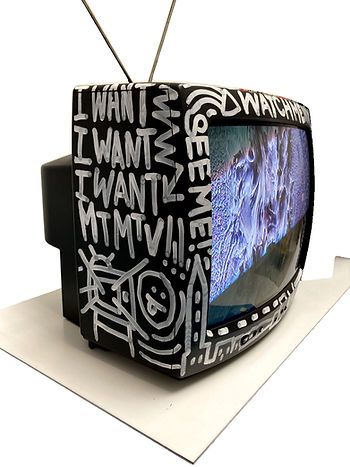
The video told me to stop when it reached 5:13 minutes. As far as the installation itself, it wasn’t done when the video was finished. Here comes the cherry. Days before the opening of Unfurling 250, when Natalie Hope McDonald dropped off her work for the show, I impulsively asked her if she wanted to tag the TVs on opening night. “Hell, yeah!”, was her response (or something like that). I told her to do whatever she wanted. “John Dowell is the subject of the video and the title is Blue White Red. Everything else is up to you”, I told her. She works in the style of graffiti, another American contribution to the world’s creativity. Anything she did was going to respond to what is already there, conceptually or physically. I love her work and the idea of another artist participating and being seen. And she nailed it! So, now, the television sets themselves pop. They have a message coming from their screens and messages all over their shells since that opening night.
And that’s how this video art installation became a collaboration between three artists using three different mediums and sharing three different messages. In harmony. Synergistic. I guess I am an artist after all. Full circle ;)
All my best,
Patricia Yáñez

What more can I say; this woman is my daughter and I can only be proud of her accomplishments. She has been through difficult times but never gave up! Chapeau to her!!!